Posts

Ayomide O. Tayo republishes and misattributes my photos


Imagine my delight: I lazily type 'Nigerian lorry art' into the search window of Google News. – Yes, I was stuck and needed a moment's diversion. – And, there is actually a rather recent article that comes up. 7 October 2016. Amazing, I think. Something I can use in my write-up maybe?
Now imagine my disappointment when I click on the link to find this:
The Nigerian Coat of Armsin Maiduguri, Nigeria: One of my photographs misattributed by Ayomide O. Tayo of the Pulse NG

This is one of my photos that I took in Maiduguri in 2008. It's one of those that I posted on Flickr because I thought it'd be nice to contribute to the group on African truck art there. Only, it is not attributed to me but one 'Tropicaliser.'
Of the six photographs in the article, four are mine. I have posted all of them on Flickr and/or Animus. And all have been misattributed. 
Old Cowboy in Kano: misattributed by Ayomide O. Tayo of the Pulse NG
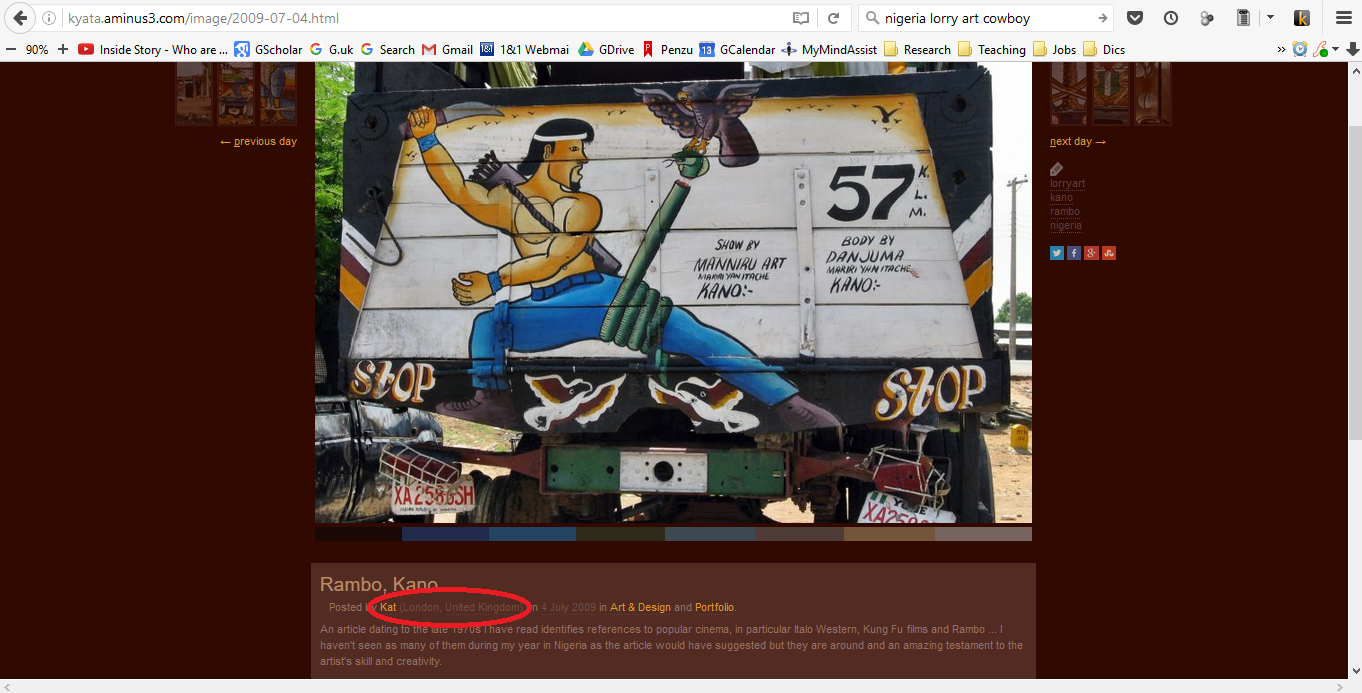
Rambo in Kano, Nigeria: misattributed by Ayomide O. Tayo of the Pulse NG
Eagle in Blue in Kano, Nigeria: misattributed by Ayomide O. Tayo of the Pulse NG
This gets me. I don't mind my photographs being used. I only like to be acknowledged as their source. – And, I really resent that my photograph is attributed to somebody else. Look, the other photograph by Mike Blyth is most likely from the African Truck Art pool at Flickr. So, if you've been there – how come you misattribute my photographs?


So, let me clarify something: I don't mind my photographs – or, indeed, anything I post here – to be reused. I don't even mind a newsoutlet (is that what Pulse NG is?) using it, even less a Nigerian one. I just think its good manners and indeed a matter of professionalism for journalists to mention your sources (with the obvious exceptions that don't apply here). And, yes, I expect you to get that right (more or less, at least, we've all been guilty of the odd typo here and there). I may want to use these photographs somewhere some day in a publication – and, I don't want some misattribution to muddy the waters on who has the copyright for them.
So, here are the links to my Flickr and Animus albums of photos of decorated lorries I have taken in Nigeria (both of which, Flickr and Animus I neglected while I was off).


In a sense this is timely. Only the other day I posted bits from an article on copy right in Nigeria that I found in West Africa magazine. Sigh. And, yes, I am currently resentful. Which is why I only give you the link to said article in Pulse NG down here. Not that it adds much to anybody's knowledge of Nigerian lorry decorations. Which annoys me even more.

Cowboy Snippets: Sam Omatseye in The Nation


As I said, I am currently interested in all things Westerns, cowboys and Nigeria in order to make sense of paintings of cowboys at the back of lorries. Here's one more snippet I found. This is Sam Omatseye writing in The Nation on 25 April 2016.

As a boy, I was a fan of the western, or what we know here as the cowboy drama or movie. I did not only watch their heroics, I played them. I was Michael Landon who played Little Joe in the Family Cartwright show called Bonanza. Dan Blocker was too fat and impetuous for me. Lorne Greene was too old and hoary. When I didn’t play Little Joe, I eased into the equine razzle-dazzle of Buffalo Bill, Jr, starring Dick Jones.
I also gathered their picture cards attached to every chewing gum item I bought. I did not only admire the dynamics on screen, I also loved their names, including those I never saw on screen, like Bob Big Boy Williams. They spun tales of the west, of the good guys versus the bad, of horse ride fights, bull fights, gunfights on plains and craggy highlands, of bar brawls and chivalry. They had guns, rode horses and, lasso in hand, controlled a herd of cattle. Their fashion fascinated me. Their hats with the wide, floppy rims; their bandana, the boots, their tops that came across as a cross between a soldier and civilian attire. The good guys were often winsome like Little Joe.
I loved their confidence. The cowboy was debonair before he felled his foe. So, you saw him as a noble figure.  The Indians were for the most part the bad guys, hooting, tactless, ungainly, their faces tarred, dark and ugly and inevitably doomed.
The image lingered in me for years even after I stopped watching the westerns. It was at the Obafemi Awolowo University, Ile-Ife when I studied American history under Professor Richard Olaniyan that I came to understand that I was fed a myth by Hollywood. The story of the cowboy as hero and vanguard of high values was part of the American tendency to romanticise the past. I began to repaint the Indian in my consciousness and asked their forgiveness. I learned of President Andrew Jackson, who drew a trail of tears with the slaughter of Indians. His face is being replaced by Harriet Tubman, a black abolitionist, as part of the American quest to restore truth to history.  From my studies, I knew that the cowboy was only a little different from the Fulani herdsman.

By the way, I was a little surprised how popularly Bonanza features in the few personal recollections of Nigerians watching American Westerns I have found so far. I guess that means I shouldn't underestimate the significance of the TV in shaping at least middle class (I know, I know the terms isn't particularly exacting when applied outside of European contexts but, pls., forgive my using it as a shorthand here) experiences of 'the cowboy.' It's also rather fascinating because I suddenly remember how prominently this very series also featured in my childhood TV viewing. World's a village, no?

Daily Trust (Nigeria): IICD Artists in Residence Open Studio


The Daily Trust ran an article on the artists taking part in the International Art Residency programme of the International Institute for Creative Development in Abuja and their meeting with Professor Jerry Buhari – whose work I really like and who is as kind and generous a man. The article quotes him saying that

'In sharing ideas here, we connect not just on art, but globally, culturally, and are looking at the diversity of experience and differences in geographical experiences.
I started by showing one of my performances which is one of my current directions. In ‘Man and Earth,’ I was exploring the relationship between the human and environment where I picked elements like prayer, ablution and so on. The whole idea is to cause man to see the need to realize that he is a gardener.'

In case you're interested – and happen to be in the vicinity of Abuja : IICD's artists in residence have open studio on 19 November 2016 from 3pm at 4 Oguda Close off lake Chad Crescent, Maitama Abuja.

"We can pick up any book published by any foreign author and reprint and adapt it to our society"


This is interesting. Although, admittedly, I cannot quite put my finger on why I feel that way about. I really feel that there is something here that could feed into one or the other argument I should be making. Right now, though, I can't quite figure it out. So, here I drop it.


The co-author of The Making of A Nation – Biafra, and chairman of the Fourth Dimension Publishing Company, based in Enugu, Anambra State, Mr. Arthur Nwankwo, has called on the Federal Government to withdraw its membership from the World Copyright Association. He said the withdrawal would help Nigeria conserve her foreign exchange and the huge amounts paid as royalties to multinationals in buying copyright. Mr. Nwankwo argued that knowledge was not a property of any race or country. He stated, "We can pick up any book published by any foreign author and reprint and adapt it to our society". He said he was in support of Government participation in the book industry, because it has the capacity to compete with the multi-nationals, who he said, flood the country with bad books that are responsible for cultural degeneration in the society. Mr. Nwankwo said that the Federal Government should have the courage to censure such books and control the rising cost of books artificially created by the multi-national corporations. The FDPC chairman alleged that multinationals still infiltrate all the ministries of education throughout the country and therefore controlled what the people learnt in schools. He stated that the effect of the Federal Government indigenisation programme has not been felt in the publishing industry. This unhealthy situation would be rectified if the Federal Government encouraged indigenous publishing companies by giving them soft loans and by participating in joint publishing venture with them, Mr. Nwankwo stated.

(West Africa, 7 July 1980, p. 1255)