Ayomide O. Tayo republishes and misattributes my photos
Imagine my delight: I lazily type
'Nigerian lorry art' into the search window of Google News. – Yes, I was stuck
and needed a moment's diversion. – And, there is actually a rather recent
article that comes up. 7 October 2016. Amazing, I think. Something I can use in
my write-up maybe?
Now imagine my disappointment
when I click on the link to find this:
 |
| The Nigerian Coat of Armsin Maiduguri, Nigeria: One of my photographs misattributed by Ayomide O. Tayo of the Pulse NG |
This is one of my photos that I
took in Maiduguri in 2008. It's one of those that I posted on Flickr because I
thought it'd be nice to contribute to the group on African truck art there. Only,
it is not attributed to me but one 'Tropicaliser.'

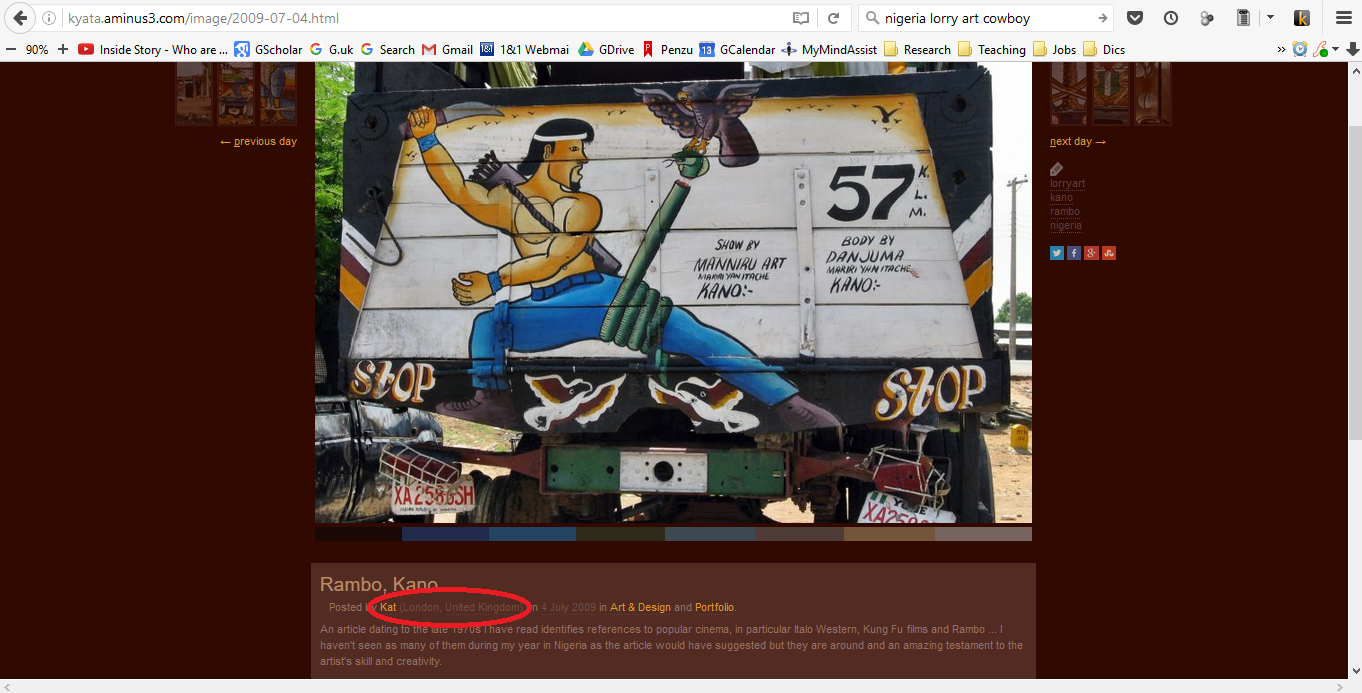
Of the six photographs in the article,
four are mine. I have posted all of them on Flickr and/or Animus. And all have
been misattributed.
 |
| Old Cowboy in Kano: misattributed by Ayomide O. Tayo of the Pulse NG |
 |
| Rambo in Kano, Nigeria: misattributed by Ayomide O. Tayo of the Pulse NG |
 |
| Eagle in Blue in Kano, Nigeria: misattributed by Ayomide O. Tayo of the Pulse NG |
This gets me. I don't mind my
photographs being used. I only like to be acknowledged as their source. – And, I
really resent that my photograph is attributed to somebody else. Look, the
other photograph by Mike Blyth is most likely from the African Truck Art pool
at Flickr. So, if you've been there – how come you misattribute my photographs?


So, let me clarify something: I
don't mind my photographs – or, indeed, anything I post here – to be reused. I don't even mind a newsoutlet (is that what Pulse NG is?) using it, even less a Nigerian one. I just
think its good manners and indeed a matter of professionalism for journalists to mention your sources (with the obvious exceptions that don't apply here). And, yes, I expect you to get
that right (more or less, at least, we've all been guilty of the odd typo here
and there). I may want to use these photographs somewhere some day in a
publication – and, I don't want some misattribution to muddy the waters on who
has the copyright for them.
So, here are the links to my
Flickr and Animus albums of photos of decorated lorries I have taken in Nigeria
(both of which, Flickr and Animus I neglected while I was off).
In a sense this is timely. Only
the other day I posted
bits from an article on copy right in Nigeria that I found in West
Africa magazine. Sigh. And, yes, I am currently resentful. Which is why I only give you the link to said article in Pulse NG down here. Not that it adds much to anybody's knowledge of Nigerian lorry decorations. Which annoys me even more.