Posts

Goldberg 2000 Bestiaire et Culture Populaire Musulmane et Juive au Maroc

Sometimes you find gems in the most unexpected places – and a book that should be required background reading for anybody attempting to study the religious chromolithographs that were produced and consumed during parts of the 20th century by Muslims in the Levant, North Africa and West Africa in the library of the Natural History Museum.

I am indebted for this find to a hint from Mirjam Shatanawi of the Tropenmuseum in Amsterdam I received via the H-Net list for Islamic Art. The book she recommended is Bestiaire et Culture Populaire Musulmane et Juive au Maroc by Andre Goldberg, a sort of dictionary of the significances of different animals in Moroccan popular culture. And, yes, at first it doesn’t sound like anything relevant to the study of religious chromolithographs. But bear with us.


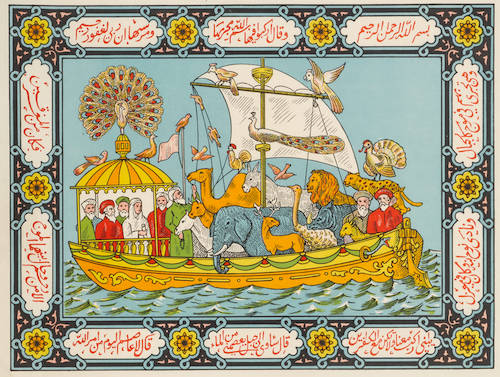
The chromolithograph depicting Sheikh Ahmad Tijani al-Hasani shows him accompanied by a gazelle while a falcon (eagle?) is cruising the sky above him. A lion rests next to Ali in the print that shows him surrounded by his sons Hassan and Husayn as well as to the feet of Sheikh Abd al-Qadir al-Hasani. Animals populate the Ark of Nuh/Noah. And, iconographically related prints in other collections include a snake and, more curiously, a peacock into the depiction of the primordial couple, animals in the court of the Solomon, a lion in the image showing the imprisoned Moroccan Sheikh Rahal al-Boudali (top row, to the right of Ibrahim/Abraham’s sacrifice) and the lions, snakes and scorpions in the illustrations of the tomb of Sheikh Ahmad al-Rifa’i.

So, clearly, anybody interested in the iconography of these religious images needs to consider the significances of these animals in the popular cultures that produced and consumed them. And that is where Goldberg’s book comes in. That, and the fact that it illustrates and discusses a selection of religious chromolithographs collected in Morocco some of which were produced in Casablanca and others imported from Cairo.

I have only started reading the book – being written in French it takes me double the time that an English or German language volume would – and I am happy finding illustrations of a number of chromolithographs. Another useful piece in the puzzle. I am also captivated by the multiple significances that these animals connote(d) in popular Moroccan culture. Of course, while some of these meanings may have been shared across the region in which the religious chromolithographs were produced, others will have been interpreted differently in the various local contexts including in Nigeria. Nevertheless, as I already said, it is another piece in the puzzle – and a push in another, hopefully fruitful direction of inquiry.

P.S. Did I mention that Goldberg also illustrates vehicle arts in Morocco, thus (on a comparative level) contributing to another strand of research I’d like to explore further …

Vanishing Art: Art Works Incorporating Religious Prints

Not sure I understand what’s going on here but considering that I’ve spend the last few days re-immersing myself into my research into religious chromolithographs its fascinating: popular religious imagery re-emerging in … oh, well, that’s the bit I’m not sure I understand: “vanishing art.” And, its too late for me to try again, I’m too tired. All I wanted to do was share with you those rather curious images. Enjoy.

al-Buraq an-Nabi (The Buraq of the Prophet), 2010

Note sure I have seen many images closely resembling this one but then, the fact that al-Buraq seems to fly westward may be taken to suggest that this is another illustration originating from South Asia which is simply not my area of, err, ‘expertise’ (in so far my limited insight can be called ‘expertise’ at all). Anyway, it’s interesting: probably the only illustration of al-Buraq I have seen that depicts the animal with blond hair. Not sure this is of any further significance, though.

Founding the Fatimid Order Cairo, NY, August 20, 2010

If I’m not mistaken, the image in question depicts Zuljana or Dhuljanah or Dul Dul, the horse of Husayn ibn Ali. Once more I am handicapped by my lack of Arabic but I am sure I have seen similar images reproduced in poster format in collections of popular Muslim imagery including the volume by Centlivres & Centlivres-Demont and the Tropenmuseum in Amsterdam. The print in the collection of the Tropenmuseum was collected in India. According to the information provided by the museum (in Dutch), the background (the pyramids apart), actually depicts an idealised heavenly garden characterised by a stylistically Indian (Mughal?) building with minarets and a tomb (reference: Debris 2008: 510-12).

Now, why the title of the collage as well as the English-language caption at the bottom of the postcard suggest an Egyptian rather than Indian connection, I really don’t know. Maybe this particular postcard originated in Egypt, maybe its simply artistic freedom (the inclusion of the artist’s initials and surname in the caption would suggest the latter). Equally, I don’t quite understand (but, again, I haven’t quite managed to weave my head around the concept of “vanishing art” the artist, Peter Lamborn Wilson, refers to) why this motif would be considered (part of) a project called “vanishing art.” It seems to me that the production and consumption of similar images continues via Indian street traders and the internet. What really fascinates me about the particular piece used in this artwork, is that it appears to be a postcard. There is even what looks like a postal stamp in the upper left corner. – Seriously, somebody help me out: Is/Was this the only motif available in this format? If not, what other motifs are/were available? Where are/were they produced and predominantly consumed?

Bonhams, Islamic and Indian Arts Sale, 19 June 2011, Lot 58

I tend not to comment on politics here, especially Nigerian politics. I follow them but I don’t think I do understand them well enough for any opinion worth your time. And, anyway, I probably use the very same sources that you do, thus having little to add. (Although in private I do have opinions, however uninformed, and feel for anybody who was injured or lost relatives in any of the outbreaks of violence. Allah ya kiyaye Najeriya. Allah a kawo sulhu. If I remember my Hausa correctly.) So, instead of commenting on yesterday’s events, I’ll offer something I know a little bit more about: another comment on the religious posters I collected in Kano and the international trajectories of this tradition of visual piety.

A few weeks ago I mentioned here that I had stumbled across the illustration of an Egyptian print depicting al-Buraq in the catalogue of a British auction house. I got in contact with them and they were really kind and helpful. Yesterday I had a brief telephone conversation with the owner. Today, I went to Bonham’s in London and had a chance to have a quick look at the whole set of prints. I worry a bit about the impression I made but, in my defence, I hadn’t slept well and had a stiff walk there after waiting half an hour for a bus that is supposed to come every 4-6 minutes. With my social inadequacies and student wardrobe I don’t come across as particularly professional at the best of times but today I actually failed: I really should have asked to sit down and spend a bit more time with these prints and looking a bit more closely. I am sure that would have been alright and much more professional than sitting here now and realising the details I should have paid more attention to. Anyway. What’s done is done. And, it’s been helpful nevertheless, first of all for the opportunity to see in the original and actually feel some of these prints I had been reading about. So, what else did I find out (apart from a lesson in how not to conduct your research)?

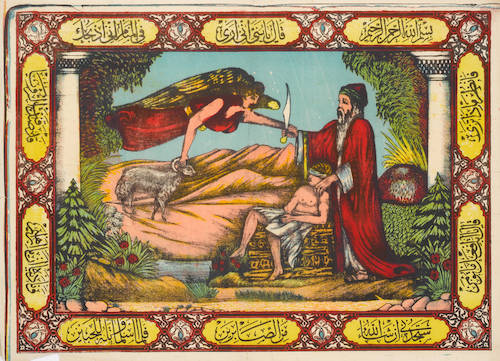
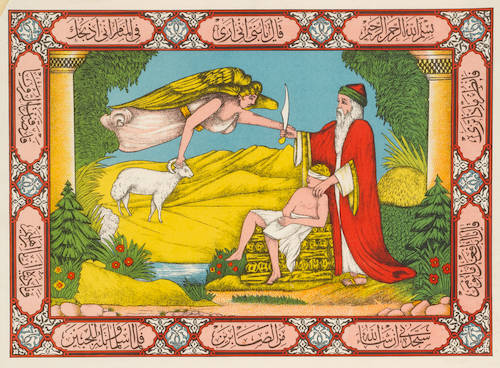
The set I looked at consists of ten chromolithographs that, according to the owner Ali Ahmed, were produced in Cairo in the 1920s. This coincides with the period during which according to one of the scholars who studied these prints, Peter Schienerl, this tradition of chromolithography took roots in Cairo. They illustrate Nuh/Noah’s Ark, Ibrahim/Abraham about to sacrifice his son Ishmael/Isaac, the court of King Solomon, al-Buraq, the Imam Ali ibn Talib accompanied by his sons Hassan and Husayn, and Khaled bin al-Walid. The chromolithographs are of two different sizes, 416x567mm and 250x330mm. The set of larger prints includes Nuh/Noah’s Ark, Ibrahim/Abraham’s sacrifice, al-Buraq, Ali with his sons, and Khaled bin al-Walid. The smaller prints illustrate Nuh/Noah’s Ark (2x), Ibrahim/Abraham’s sacrifice and al-Buraq. The printer’s marks are only visible on some of the larger prints and, according to Bonham’s (yes, I need to get back to my Arabic lessons), they identify their producer as Matba’at al-funun al-Jamilah. This appears to be the company, Fine Art Printers, to which Schienerl refered to as the major producer of what religious chromolithographs in Cairo between the 1920s and the mid 1970s. The smaller prints lack printer’s marks. I am not sure whether they are of the same age as the larger prints. Schienerl suggested that the smaller prints represented another generation of religious chromolithographs that emerged in the 1970s. But, who am I to question the assessment of the owner.

Personally, I was particularly surprised by the quality of the larger prints. Unlike the prints I collected in Kano, they displayed a larger variety of colours and shading was executed more delicately. The smaller chromolithographs, however, were characterised by a reliance on block colours and hatching similar to the Nigerian prints. I think this is particularly apparent if one compares the larger sized chromolithograph depicting Abraham attempting to sacrifice Ishmael/Isaac with the smaller sized one in the set and the print I collected in Nigeria in 2008 (sorry, Bonham reserves the copyright for its images so I can’t juxtapose them here, instead pls. make use of the links).

Again, some of the chromolithographs in the set displayed a close resemblance to the respective motif in the set of prints I collected in Kano. These include the illustrations of Nuh/Noah’s Ark, Ali and his sons, al-Buraq and Abraham’s sacrifice of Ishmael/Isaac.

Interestingly enough, the larger of three prints in the set illustrating Nuh/Noah’s Ark presents the motif on a plane sheet of paper without any decorative borders but includes inscriptions including of the shahada on the ship’s pennant. In this it resembles an illustration of the same motif by Kriss & Kriss Heinrich and collected in Cairo in the 1950s as well as the print I collected in Kano in 2008. The two smaller sized chromolithographs are distinguished by a decorative border including (and here it comes again, I need to take Arabic lessons again) what I guess are the respective verses from the Qur’an. They also present a mirror version of the motif depicted in the larger print in the set. No other inscriptions have been incorporated into the image. In all but the absence of the inscription in the pennant, the Nigerian print appears to follow the larger of the three chromolithographs.

Another interesting aspect that was raised during the conversation with the prints’ current owner Ali Ahmed: He explained that this kind of images was more closely associated with Shi’ism rather than practices of Sunni Islam. Interestingly enough, Elisabeth Puin and Schienerl indeed argued that this tradition of religious imagery may be traced back to Iran. However, these images appear to have been produced and found audiences among Muslim populations in an area stretching from Morocco to the west to Syria in the east, from the costs of the Mediterranean to the north to the Sahel belt to the south. If I am not mistaken, the areas on the African continent are predominantly, if not exclusively, Sunni. So the appeal of these images cannot be limited to Shia Islam. Maybe, Khenchelaoui provided a clue here when he discussed similar chromolithographs within the context of pious practices associated with Sufi Islam in Algeria, in particular the reverence of the Sheikh Abd al-Qadir al-Jilani. Or, maybe, Ahmed’s assessment reflected contemporary interpretations of Islam’s teaching about the arts and the use of religious imagery that have changed since the period during which these chromolithographs were produced in Egypt. I don’t know (yet) but these certainly are interesting questions to explore. No?

All references here. (Oh, the ease of inserting just one link, I should have posted my bibliography on a separate but associated page much earlier!)

Nka Roundtable III: “Contemporary African Art and the Museum”

Chika Okeke convenes another virtual roundtable at the Nka blog.

Nka Roundtable III: “Contemporary African Art and the Museum”

Over the next several weeks curators and directors of major museums in the United States, Germany, Japan, South Africa and the UK will engage in spirited but substantial discussion on the relationship between contemporary African art and the museum. I expect excursions into the history of this relationship, its crucial moments, state of affairs, and challenges that remain. In the process, we shall debate issues of presenting this material in art and ethnology museums; the politics of acquisitions and display; museums and scholarship; and the place of contemporary African art–relative to the “traditional” and western contemporary. I suspect that there will be surprising turns in the course of our discussion, but I am certain that the deliberations of this diverse, unprecedented and distinguished panel of curators will surely be of immense value to students and scholars working or interested in this exciting, dynamic field. Please join us!

Convener: Chika Okeke-Agulu (Princeton University)

Participants: Marla Berns (Director, Fowler Museum of Cultural History, University of California, Los Angeles), Christa Clarke (Senior Curator, Newark Museum, Newark, NJ), Laurie Ann Farrell (Director of Exhibitions, Savannah College of Art & Design Gallery, Savannah, GA), Khwezi Gule (Chief Curator, Hector Pieterson Memorial, Johannesburg), Kinsey Katchka (independent scholar/curator), Yukiya Kawaguchi (Associate Professor/Curator, National Museum of Ethnology, Osaka), Clive Kellner (Curator-at-Large, The Gordon Schachat Collection, Johannesburg), Karen Milbourne (Curator, Smithsonian National Museum for African Art, Washington DC), Raison Naidoo (Director Arts Collections, Iziko: South African National Gallery, Cape Town), Enid Schildkrout (Chief Curator/Director of Exhibitions, Museum for African Art, New York) Chris Spring (Curator, British Museum, London), Ulf Vierke (Director, Iwalewa-Haus, University of Bayreuth, Bayreuth), Okwui Enwezor, Salah M. Hassan.

Surely, once again, worth following closely … Find it here.

CCA, Lagos: Art-iculate Lectures Series, Spring 2011

In my inbox this morning …

Art-iculate Lectures Series, Spring 2011

In 2008, Centre for Contemporary Art, Lagos began the Art-iculate Lecture Series to increase dialogue, encourage debate and stimulate exchange in visual art and culture in Nigeria. By prioritising the provision of an independent discursive platform through our public programmes, we actively encourage the development of critical perspectives as well as engage with topical issues that affect our society specifically as well as the world at large. To much acclaim, Art-iculate has featured lectures and presentations by Slyvester Ogbechie (U.C, Santa Barbara), Didier Schaub (Doual'Art, Cameroon), Solange Farkas (Videobrasil, Sao Paulo), Yacouba Konate (University of Abidjan), Monna Mokoena (MOMO Gallery, Johannesburg), Shahidul Alam (Drik Agency, Dhaka) and Chika Okeke-Agulu (Princeton University), amongst others.

Date: Wednesday, April 20, 2011, 4:00 p.m.

Venue: Terra Kulture, 1376 Tiamiyu Savage Street, Victoria Island

CURATOR TALK

Kristina Van Dyke

Kristina Van Dyke is Curator for Collections and Research at the Menil Collection in Houston, Texas, where she co-manages the curatorial department and oversees the museum's archives, library, and exhibitions department. She received her M.A. from Williams College and her Ph.D. from Harvard University, writing her dissertation on the nature of representation in the oral cultures of Mali. Since arriving at the Menil in 2005, she has curated Insistent Objects: David Levinthal's Blackface, Chance Encounters: the Formation of the de Menils' African Collection, and Body in Fragments. In 2008, she reinstalled the African galleries and published African Art from the Menil Collection.

Kristina Van Dyke will provide an illustrated overview of The Menil Collection's history and discuss its unique curatorial philosophy. She is currently developing three research projects: a study of Malian antiquities and cultural heritage issues; an exhibition exploring skull imagery in sculpture from Nigeria, Cameroon, and Gabon; and an exhibition on the theme of love and Africa.

ARTIST TALK

Yinka Shonibare, MBE

Internationally acclaimed Nigerian artist Yinka Shonibare MBE will discuss his artistic trajectory over the past two decades, presenting key themes from his vast and diverse artistic practice.

Yinka Shonibare, MBE was born in London and moved to Lagos, Nigeria at the age of three. He returned to London to study Fine Art first at Byam Shaw College of Art (now Central Saint Martins College of Art and Design) and later at Goldsmiths College, where he received his MFA-graduating as part of the ‘Young British Artists' generation. Shonibare has become well known for his exploration of colonial and post-colonial themes. His work explores these issues through the media of painting, sculpture, photography and, more recently, film and performance. With this wide range of media, Shonibare examines in particular the construction of identity and the tangled interrelationship between Africa and Europe. Having described himself as a ‘post-colonial' hybrid, Shonibare questions the meaning of cultural and national definitions. In 2004 Shonibare was shortlisted for the Turner Prize and in 2009 he won a commission for the Fourth Plinth in London's Trafalgar Square, for which he unveiled in 2010 a scale model of Nelson's ship HMS Victory in a bottle. He has exhibited at the Venice Biennial and internationally at leading museums worldwide.

This edition of Art-iculate is supported by Shonibare Studio, The Menil Collection and Terra Kulture.

Shonibare's visit is supported by The Menil Collection, Houston and is part of the preliminary research for work to be presented in the forthcoming exhibition Love and Africa (2012–13) taking place in Houston and Lagos in collaboration with CCA, Lagos.

For inquiries, please contact info@ccalagos.org, or visit www.ccalagos.org.

Naija Langwej Poetry Contest

I don’t really understand much about poetry. I read (not as much as I used to) but not really poems. I enjoy rhythm and rhymes but in songs and recitations. So, I don’t really know much about what I am going to advertise right now. But, it sounds interesting. And, I have a soft spot for Pidgin.

Call for Submissions: Poems in Nigerian Pidgin

Arojah Concepts, an Abuja based edutainment outfit in collaboration with SOMETIN FO EVRIBODI has concluded plans to publish an Antoloji of Naija Puems (Poems in Nigerian Pidgin) and thereby wishes to invite interested Nigerians to send in their entries.

The anthology which will be released in the third quarter of the year is part of efforts by the organizers, in collaboration with the Naija Langwej Akademi and the Institute Francaise de Recherche en Afrique au Nigeria (IFRA Nigeria) to promote writings in Naija Langwej (aka Nigerian Pidgin) which is growing steadily across the country.

Send between 3 and 5 poems written in ‘Naija langwej’ (Pidgin English) to arojahconcepts@yahoo.com or edbabor@gmail.com.

Conditions:

* Submissions need to be original and have not been published before

* Submissions should not exceed 2 pages using MS Word format (Garamond, 14 point)

No topics have been specified and contributors are free to explore any theme and subject of their choice including the Nigerian and other cultures.

Ten poems will be selected from all the entries received and the poets will receive various categories of prizes in appreciation of their creativity.

Submissions need to be received before Friday 29th of April 2011.

Submissions to arojahconcepts@yahoo.com or edbabor@gmail.com. For further enquiries pls. contact 0803 453 0786 or 08080900813

Ulli Beier

This weekend Ulli Beier died.

Reading through obituaries this morning and flicking through biographies I feel the loss not only of a pioneer of the art histories of non-Western cultures but a whole generation of intellectuals. Still, I wonder whether there still are those who like Ulli Beier who came to Nigeria in 1950 and deeply involved himself in the country’s then burgeoning creative scene, whether in this I could follow his example or whether I even should. He was instrumental in the foundation of the Mbari Artists and Writers Club in Ibadan and later the Mbari Mbayo in Osogbo as well as the magazine Black Orpheus. The Osogbo art workshops of 1964 (did I get that date right?) produced artists and artistic traditions that, again through his tireless promotion organising exhibitions, gained international reputation. And, as a German I have to mention his role in the foundation of the Iwalewa House at the University of Bayreuth that remains an important space for the promotion of non-Western arts in Germany (and for a moment almost tempted me to Bayreuth for my PhD). Maybe I am just idealising a past that, with hindsight, appears ripe with opportunities and creativity and overlooking its challenges and problems, especially when viewed through the current anxieties of my upcoming viva and applying for post-doctoral positions. Maybe. And, surely there are those I today admire for their work in Nigeria and across the continent. But, judging by the obituaries in Nigerian publications this was a man who – like is former wife Susanne Wenger who died two years ago - is still remembered for this contribution to contemporary Nigerian arts in the 1950s and 1960s and, judging by the obituaries (already here, here and here), is fondly remembered for his contribution beyond the small professional and academic world of contemporary Nigerian arts.

Respect. And, RIP.

P.S. Chika Okeke has published a lovely poem on his blog.

The Visual Culture of Nigerian Politics: Police Detain(ed) Cleric over Goodluck Jonathan's Campaign Poster

Some while ago the Daily Trust reported that a prominent Sokoto-based scholar has been arrested on charges of defacing posters promoting the campaign of current president Goodluck Jonathan:

Police detain cleric over Jonathan’s posters

Daily Trust, Wednesday, 02 March 2011 00:00

Rakiya A. Muhammad, Sokoto & Misbahu Bashir, Abuja

Prominent Islamic scholar in Sokoto Sheikh Abubakar Jibril was arrested by the police on Monday afternoon and was flown to Abuja yesterday over what police sources said was the defacing of some campaign posters of President Goodluck Jonathan. The Sheikh, who is the Chief Imam of the Farfaru Juma’at Mosque in Sokoto, was arrested with his two sons, his driver and a domestic aide, according to relations and the police. Spokesman for the Sokoto police command ASP Al-Mustapha Sani said policemen on patrol arrested Sheikh Abubakar and the others while they were using black paint to deface the posters of the president and his deputy at some roundabouts in Sokoto metropolis at about 5pm on Monday.

Sani said they were arrested over inciting public disturbance and have been transferred to the Force Criminal Investigation Department in Abuja.

In Abuja, the Force Public Relations Officer DCP Olusola Amore confirmed that five people including Sheikh Abubakar were being held at the Force CID and that they were arrested for allegedly defacing the posters of the PDP presidential candidate and his running mate. He said they were also suspected of inciting dislike for Jonathan and of acts capable of fanning the flames of public disturbance.

[…]

But a civil society activist, Ibrahim Tudun Doki described the arrest as political intolerance by the Jonathan regime. Tudun Doki, who is a House of Representatives candidate of the Congress for Progress Change [CPC] recalled that General Muhammadu Buhari’s campaign billboard was destroyed in Port Harcourt, Rivers State last week and that the police did not arrest or charge anyone to court for the action.

[…]

Read the full article here:

I am not in a position to comment on the accusations or the political ambitions that may or may not have informed the whole incident. And I have been hovering about how to express my kind of perspective in a way that fit this blog. Let me try.

I am fascinated by the idea that authorities in Sokoto would accord sufficient significance to the disfigurement of the current president’s campaign posters to take such drastic action. My interest in the relationship between (aspects of) visual culture and politics predates these news. Visually one of the defining impressions of my spring/summer 2007 visit to Nigeria was the prevalence of murals of politicians alongside the roads on which I travelled. Even in what appeared to me more remote areas of the country, there was the occasional house on which the portrait of a politician had been painted (as well as those ‘decorated’ by an advertisement for, if I remember correctly, Simba Motors). During a stroll through Zaria’s old town I stumbled across the abandoned signs portraying politicians. What an effort and what skill invested into visual communications considering that I had been previously warned to expect an impoverished visual culture. It also highlighted that there was a political culture that employed visual means of communication. And, that is rather interesting. It contradicted some of the statements I had read in the limited body of literature that spoke about visual culture in northern Nigeria.

There are prominent historians of Nigerian arts who argued that Islam had prevented the development of ‘meaningful’ (whatever that means) traditions of visual arts in the region or that, alternatively, it had only sustained abstract, aniconic artistic traditions. Instead, incidents like this one suggest that, in addition to a lively visual culture of politics, there is a substantial investment in these images. Why else the drastic reaction? This iconoclasm, if that is what you want to call it, is not religious but political. Not unlike the global Muslim reaction to the Danish cartoons cannot be understood in religious terms only. As Jytte Klaussen has demonstrated the political context in which these images were published significantly contributed to the escalation of the affair. This is not to say that northern Nigerian visual culture is not influenced by the presence of Islam and prominent interpretation of its sources with regard to the arts. For example, it would be interesting to know why President Goodluck Jonathan has chosen to promote his campaign using music videos – including a short song in Hausa[1] but Ibrahim Shekarau hasn’t.[2] The answer is probably complex but I wouldn’t be surprised if (in the widest sense) religiously inspired attitudes towards music videos and the dancing they depict had played a (possible small) role here. But to restrict the discussion of visual culture in northern Nigeria to the religious argument, would clearly mean to miss important dimensions. And, surely, this incident is another reminder of just that.


[1] I got no political investment here on any side but I was too happy to find I had not totally forgotten Hausa not to link to it.

[2] Or did I just not find it on Youtube, correct me if I'am wrong! Pls. I’d love to know.

Searching for references to the arts in colonial memoires: Noel Rowling (1982) Nigerian Memories.

The memoires of colonial officers in Nigeria and their wives are weird reads. How to best describe why? Well, I guess this sentence almost at the very end of Noel Rowling’s (1982: 77) Nigerian memories summarises it:

‘People to whom colonialism is a dirty word never seem to understand that it was only because we believed in what we were doing that we were able to cope with miseries like that.’

It is hard to accept that they thought they did what was right – but then, I am German and thinking of the generation of my grandparents, the atrocities committed by Germans in WW2, who am I to judge? It is hard to read past the colloquial racism and the prejudices. Sometimes it is so bad it gets almost satirical. I don’t mean to pick on Mrs. Rowling in particular but she has a gift for expressing her sense of the superiority of English civilisation and, sometimes, self-importance in phrases that make me simultaneously squeal and laugh out loud. This is one of my favourites (p. 28-29):

I found the Bible a book I could translate into Hausa, as life in Africa 1935 was very similar to life in Palestine when Jesus was alive.

Surely, this comparison would have British colonial officers and their wives as members of the Roman occupying forces, no? But, you probably cannot expect anybody in the eve of their life to completely pick it apart and question the very foundations upon which it was built. Or can you? It nevertheless makes those memoires rather uncomfortable reads. But those memoires nevertheless, provide one or the other gem that goes via my research. An expression of admiration for the architecture of Kano here, a casual remark about Nigerian reckless drivers and their reliance on appeals to divine protection written across the backside of their lorries there. So, let me share some of them:

Architecture and wall decoration in Kano:

p.11

Kano City was a very old city, surrounded by a mud wall with carved entrance gates at the four points of the compass. Nearly all houses were built with sun-baked mud bricks and often colour washed. Those belonging to rich merchants and members of the royal house were usually big square buildings with ornamented walls and doors, and with flat roofs where the ladies of the harem would take the air in the evening.

p. 48

A new mosque was built while we were there, in the traditional style, and was beautifully ornamented. The colours, of all shades of brown and gold were very restful and the palm trees, mango trees, and citrus, grown haphazardly everywhere, gave plenty of shade.

[Does anybody know which mosque she maybe referring to? Is it the central mosque which was eventually replaced by the current building in the 1950s?]

Lorry Decoration

p. 44

... and so unsafe vehicles and dangerous cars were left speeding on the roads, a menace to passengers, other cars and pedestrians, with only a notice in large letters attached to the back of the vehicle saying ‘God help us’ to ensure, as they thought, that they would avoid disaster.

p. 54

African drivers are an amazing brotherhood. They nearly all drive too fast and never worry about the state of the roads. It is a common sight in the south to see a mammy wagon with the sign ‘God Help Us’ or,’ May the Lord keep us safe’ printed on the back of a lorry containing passengers.

Slightly Off-Topic: Africans in European Art

Thanks to a recent blog entry by Afro-Europe, I learned about these two sites which are surely worth sharing even if they are not in any way related to my current research interests. But I guess, they are rather relevant within wider discussions about the relationship of Europe and European artists with Africa. And, guess what, that relationship long predates Picasso. No disrespect intended (if there ever was a good commentary of on the horrors of 20th century warfare, its Guernica!). But there have been Ethiopians who adapted and transformed Byzantine Christian art. There were the so-called Afro-Portuguese ivories probably one of the world’s earliest examples of tourist art. There the influences of Christian missionaries on 15th century Congolese arts. And, of course, European artists have depicted Africans long before ideas about racial hierarchies and the slave trade affected their vision.

Panels at the Filarete Door at St. Peter’s Cathedral. According to Lowe (2006), they respectively depict Pope Eugenius IV Consigning the Decree of Union to Abbot Anthony, the Head of the Coptic Delegation at the Council of Florence and …

… The Departure of the Coptic and Ethiopian Delegates from the Council of Florence. Both were completed in 1445. (Image Source)


Bust of the Congolese Ambassador to the Vatican at the Basilica Sainte Marie-Majeure


Water Colour by Bernandinio Ignacio, a capuchin monk, 1740 (Image Source)

So, here are two websites and some publications I’d like to quickly recommend:

* The Image of the Black in Western Art is a series of publications resulting form a research project originally started by Dominique de Menil in the 1960s.

* The Image of the Black in Western Art, Volume I: From the Pharaohs to the Fall of the Roman Empire (November 2010)

* The Image of the Black in Western Art, Volume II: From the Early Christian Era to the “Age of Discovery”: Part 1: From the Demonic Threat to the Incarnation of Sainthood (November 2010)

* The Image of the Black in Western Art, Volume II: From the Early Christian Era to the “Age of Discovery”: Part 2: Africans in the Christian Ordinance of the World (November 2010)

* The Image of the Black in Western Art, Volume III: From the “Age of Discovery” to the Age of Abolition: Part 1: Artists of the Renaissance and Baroque (November 2010)

* The Image of the Black in Western Art, Volume III: From the “Age of Discovery” to the Age of Abolition: Part 2: Europe and the World Beyond (Fall 2011)

* The Image of the Black in Western Art, Volume IV: From the American Revolution to World War I: Part 1: Slaves and Liberators (Spring 2012)

* The Image of the Black in Western Art, Volume IV: From the American Revolution to World War I: Part 2: Black Models and White Myths (Spring 2012)

On their website, there is a nice image gallery and a video of a presentation by Henry Louis Gates, Jr. Two articles that have come out of the project have recently (February 2011) published in Apollo Magazine: The Image of the Black in Western Art and Race in Classical Art.

Even more resources are available on the website of the exhibition Black is Beautiful. The exhibition examines selected works by artists from the Low Lands that depicted Africans. It offers an interesting selection of short videos, for example explaining who the women is standing next to Moses in this painting by the Flemish painter Jacob Jordaens (1593-1678):


(Image Source)


Find the answer here.


These are, of course, not the first exhibitions and publications on the subject. Already in 1970, Snowden published a volume on depictions of Ethiopians in Greco-Roman Arts. In 1992 Pieterse published White on Black: Images of Africa and Blacks in Western Popular Culture.

P.S. Let me clarify, why I think these historical depictions are important. This has nothing to do with absolving Europeans from the history of slavery, colonialism and contemporary forms of exploitation. Rather, they highlight that European perceptions of Africans changed throughout time in response to historical circumstances and the nature of the relations and trade between Europeans and the African with whom they had contact. As such, they provide evidence that racism is not natural but an ideology that evolved at a particular time in response to and in order to legitimate historical relations. This is not to say that there were no negative stereotypes before the Atlantic slave trade required a re-imagening of Africans as lesser humans to justify the trade. I suspect to an extent we are hardwired to fall back on stereotypes in our relations with other human beings. Nobody can genuinely know and understand the personal and collective histories and cultural influences that make every human being on this planet the person they are. But, I guess it’s important that these images document that stereotypes can change and be adapted – and, most importantly, that they do not provide a historical truth but just one interpretation. No?