VOXAFRICA STM interviews Bino and Fino creator Adamu Waziri
A worthwhile distraction while I amend my thesis:
A worthwhile distraction while I amend my thesis:
Via Africa Is A Country, , Stuart Hall on BBC 4’s Thinking Allowed
The Prime Minister recently criticised what he called 'state multiculturalism' and said it had failed, arguing that Britain needs a stronger national identity. Is it time to turn our backs on the multi-cultural idea? And what would a stronger national identity mean to people who feel at the cultural margins of our society? As the politicians debate, Laurie Taylor speaks to Britain's leading cultural theorist, Stuart Hall. They discuss culture, politics, race and nation in a special edition of Thinking Allowed.
Producer: Charlie Taylor.
To my best of knowledge, chromolithographs illustrating Muslim religious motifs were exported from Europe to the Arab world from about the end of the 19th and the beginning of the 20th century. In a new publication, an exhibition catalogue, that I still need to lay my hands on, Malou Schneider explores images of this kind produced by an Alsatian printing house based in Wissembourg/Weißenburg. The printing press was founded in 1835 by Jean Frédéric Wentzel. According to the Wissembourg Herald Tribune, the company maintained close trade relationships with Egypt in particular.
Outre cette actualité politique, les images traitèrent sans disctinction des sujets religieux aussi bien protestants, catholiques, juifs et même arabes comme ce retour du Tapis sacré à la Mecque grâce à Hassan Auvès, le correspondant de l’entreprise au Caire qui diffusa les images de Wissembourg en Egypte !
The below video documents provides a sneak preview of the exhibition which was shown at the Alsatian Museum between October 2010 and January 2011. If you pay close attention you can get a glimpse of the prototype for one of the motifs produced for Muslim markets. It depicts a Muslim man on horseback fighting demons. A chromolithograph depicting this very same motif and collected in Morocco can be found in the collection of the Musée du Quai Branly in Paris, 'The Faithful's Fight against Demons.’
(Video Source: CultureBox)
No comment.
(this video was published here by Next Magazine)
Oh, well, I can’t help it.
As somebody who derives visual pleasure from the accidental collages of different kinds of posters and graffiti (at their best, they do liven up otherwise drab urban spaces) I have mixed emotions about this. Yes, when I was in Nigeria, the part of me that grew up on moral tales about taking responsibility for your local environment grieved at the sight of Pure Water bags in the streets. This part of me appreciates the value of what these guys are doing. But, it also makes me sad, somewhat. The colourful collages of these posters in the background of photographs documenting the recent elections (and, sadly, the violence that followed) have become an integral and iconic part of my memories of (the reporting of) these events. – Imagine our ancestors had approached the graffiti at the walls of the caves of Lascaux with the same zeal for stainlessness! …

You got to admit they add colour, no? (source: 2SpaceNet, ultimately poss. Reuters)
Yes, I do acknowledge that this are not the caves of Lascaux and that this act of ‘iconoclasm,’ I am sure, is informed by an earnest concern with public hygiene (which is why I put the ‘…’ around ‘iconoclasm’). But, that doesn’t mean that policies about the management of public spaces aren’t informed by ideologies that favour some forms of (public) expression above others and that these distinctions do not reflect broader discourses about (cultural) citizenship. I believe they do. One (wo)man’s act of vandalism is another one’s expression of a disadvantaged minority or a piece of street art. One (wo)man’s act of reconstructing a public space is another one’s act of erasing artefacts of local history or even an act of ‘iconoclasm,’ … and to this art historian the Lagos State authorities removal of election posters is also the destruction of a visual artefact of the 2011 elections and an exercise of control over a local visual culture which, to my mind, is always also a form of expression and reflection of relations and identities within a local culture.

Again, I do understand the criticism of some that election posters were pasted upon almost all available surfaces and, significantly, obscured vital signage. But, to my mind this is also evidence of an ingenious use of limited resources (here, space) and symptomatic of my experience of Nigeria: never subtle, always … well, as somebody ones put it: Nigeria is live in Technicolor. (image source: France 24)
For the record, I do not mean to criticise Lagos authorities for the removal of election posters in their state. This is not my call (even less so since I am currently still writing from London). Nevertheless, the mixed emotions with which I responded to the video got me thinking again about the contexts in which we label some objects as pieces of art and their destruction as acts of iconoclasm while we deny others this label and routinely discard and destroy them … and, yes, a reminder that at one point I will have to dig further into the use of terms such as ‘sanitation’ in policing local cultures, for the record: not only or even primarily in Nigeria.
But for now I leave it at this.
No, despite living in London I haven’t watched the Royal Wedding. Instead I tried to combine pleasure and work by taking my laptop to the balcony to soak up the sun while typing away at my article. Or so the theory went. The truth is that not much work was done that weekend. Not for a lack of trying. Honestly. Each morning I got up with the intention to work hard. I started the day with a healthy diet of tea, muesli and the news. … And then the news got the better of me. And, here I am today wondering how to finish this article on deadline …
But, again, habit got the better of me and I started the day with the news. And, of course, I came across a number of articles I’d like to take time to reflect upon. But, let’s face it: That’s a luxury I don’t have with a deadline looming. Let’s be honest: An intellectual exercise it might be, but its also just another excuse to procrastinate and not face the peer reviewers. So, instead, of writing a nice and thought through blog entry, I have scraped together whatever self-discipline I have left and decided to just post an extract and a link.
ART OF THE MATTER: In the web of plagiarism
Next Magazine, By Mufu Onifade, April 30, 2011 10:27PMT
Last month, Abiodun Olaku, one of Nigeria’s most brilliant artists and seductive colourists, alarmed the world through his Facebook page. He posted a screaming protest on his wall: “People, see what I discovered... This is the criminal activity of a young artist called Fagorusi Segun, who’s been copying and doing only-God-knows-what with my paintings… He’ll be feeling the hot breath of my lawyers very soon!”
What came to mind immediately was to search for the accused on Facebook. Lo and behold! There lay one of the pictures showing Segun at work, unbelievably plagiarising one of Olaku’s popular Gray Tunes painting series. There were other paintings with an eclectic transfiguration – still from Olaku’s collection. The next question: who is Fagorusi Segun? He is a final year painting student at the Obafemi Awolowo University, Ile-Ife, but beyond his location or affinity, Olaku’s alarm was strong enough to attract mixed reactions from many Facebook subscribers. Virtually all of them without exception know Olaku, but Fagorusi seems wallowed in obscurity. The reactions are as diverse as they reflect the perceptions of Nigerian society.
Read more here.
Update, 08 May 2011
Fagorusi Segun responds to the accusations of plagiarism in Next Magazine.
Given the economically damaging role of pirates in the industry, Mufu Onifade’s concerns are justified. Perhaps, in his and Olaku’s shoes, I might have done even worse. The work in question has a similar colour scheme but is not a copy. If you divide the two paintings into equal halves and consider the right side of mine to Olaku’s; you can hardly point out similarities. The left side could boast of only a 25 percent similarity: the road network of his is the opposite of mine, et cetera.
Thank you to the anonymous poster who alerted me to Segun’s article. I hope updating the blog post rather than publishing the link in the comment section does you justice.
And, since its Sunday morning, let me take a moment to add some thoughts.
First, maybe I should have taken the time to frame Onifade’s article when I reposted the first two paragraphs here. It uses a particular example of, naming (and shaming) a young artist in the process of raising the issue of plagiarism in the arts. In other words, what to me is one document in discourses about originality and artistic integrity has a personal dimension and, potentially, professional repercussions for the artists concerned that my particular perspective cannot account for.
Second, with hindsight I am struck by the legalistic language of plagiarism and copyright that frames both Onifade’s article and Segun’s response. Borrowing and copying are fundamental to processes of creativity. Where we draw the line between a copy and an ‘original’ reinterpretation of works that have gone before is as much a cultural as a political issue. It is highly contested (e.g. see this recent-ish discussion in the Arts Newspaper). It is also more flexibly shifting than we sometimes give it credit. We apply it differently in response to a variety of factors including historically particular cultural conventions and, let’s be honest, our personal and economic investment into particular works and traditions of art. After all, it affects an artist’s access to patronage and an art dealer’s asking power. This last point is (implicitly) acknowledged in the authors’ use of legalistic language. But that language cannot, by definition, account for the complexity and flexibility of processes of artistic creation and the ways in which we assess art works. Or at least, I don’t think so. I don’t think mathematical models of similarity are appropriate approaches here and in particular not to comparing two works of art that (as may be the case here) derive from the same tradition or genre and tackle similar subject matter. Such artists draw from a shared set of expressive and productive techniques. They may independently and without (conscious) copying derive at very similar works. Or not. In any case, formal comparison alone cannot account for these processes nor situate them within the spectrum between inspiration and intellectual theft. Or at least, I don’t think so.
There are reasons that I don’t think so and they as much reflect my intellectual engagement with the art historical literature I have read as my use of technologies (including blogger) that enable and thrive upon the recycling, responding to and rethinking of ideas and images from other (online and offline) sources. Equally, there are reasons that both Onifade and Segun chose to frame their articles in legalistic or technocratic languages (rather than, say, more philosophical approaches). – And that is where it gets interesting. That is the point at which I cannot help but see sources and starting points for discussions for the day that I return to Nigeria and get a change again to talk to Nigerian artists and art historians. Despite the fact that this limited perspective on the articles I link to, repost and discuss may not always do justice to the personal dimension of the issues they discuss.
Oh, and as we’re at it (yes, another minute I don't have to think about peer reviewers): There is an interesting article in Leadership suggesting that propositional material used in the recent election campaigns was to an unprecedented extent commissioned to printers outside of Nigeria.
For Ndubuisi of Prime Printing Press, Abuja, the Independent National Electoral Commission and other political office aspirants have forgotten Nigerian Printers and taken all the businesses abroad. “For any election, the politicians must bring money for publicity and that is how we make our own profit but I think INEC and politicians went abroad to print their campaign and elections materials leaving us with no business this year. The 2003 elections were much better than this year. It is sad that what we can do here was taken abroad to be done at a more expensive rate”.
Even during my limited experience in Nigeria, I could not but notice a fashion for all things foreign that also affected the arts. This is, of course, a problem by itself but further exaggerated by the comparatively low level of art patronage anyway (which is more than understandable if one considers the economic realities of the majority of Nigerians). Many of the artists I met struggled financially. The few who didn’t derived significant shares of their income from commissions by businesses and, to an even larger extent, political organisations. Which is why I got a lot of sympathy for Okorocha Nyam’s’ position:
“Going abroad to print campaign or election materials is not just untidy for these printers but also rubs off on Nigeria’s economy”.
Though he acknowledged that going abroad to print election materials is for expertise and quality purposes, he posited that, “the outcome is not favourable to Nigerians in terms of employability and development of the Nigerian printing press as we are in other words, helping another nation to develop its printing press and leaving our own in Nigeria to suffer.”
Read the full article here.
I am instinctively wary of all talk of economic protectionism and cultural nationalism, especially of the kind that seeks to impose rigid and essentialised categories economic and cultural citizenship, but sometimes I wonder … and then I think of the more or less successful ‘buy local’ campaigns here in Europe and how they combined arguments about quality and quality control, ecological arguments from growing organic to carbon footprints, and a sense of local community (the better ones, focusing on locality eschewing ethnic or nationalistic ideas of belonging) … and, come to think of it, the pride my Nigerian friends and acquaintances took in the work of NAFDAC …
But, here I go again, getting lost in an argument I am not actually qualified to make instead of working on my article. So, let me find whatever self-discipline I have left in the face of the blue sky and sunshine out there and make an effort to finish this article. Today.
Sometimes you find gems in the most unexpected places – and a book that should be required background reading for anybody attempting to study the religious chromolithographs that were produced and consumed during parts of the 20th century by Muslims in the Levant, North Africa and West Africa in the library of the Natural History Museum.
I am indebted for this find to a hint from Mirjam Shatanawi of the Tropenmuseum in Amsterdam I received via the H-Net list for Islamic Art. The book she recommended is Bestiaire et Culture Populaire Musulmane et Juive au Maroc by Andre Goldberg, a sort of dictionary of the significances of different animals in Moroccan popular culture. And, yes, at first it doesn’t sound like anything relevant to the study of religious chromolithographs. But bear with us.


The chromolithograph depicting Sheikh Ahmad Tijani al-Hasani shows him accompanied by a gazelle while a falcon (eagle?) is cruising the sky above him. A lion rests next to Ali in the print that shows him surrounded by his sons Hassan and Husayn as well as to the feet of Sheikh Abd al-Qadir al-Hasani. Animals populate the Ark of Nuh/Noah. And, iconographically related prints in other collections include a snake and, more curiously, a peacock into the depiction of the primordial couple, animals in the court of the Solomon, a lion in the image showing the imprisoned Moroccan Sheikh Rahal al-Boudali (top row, to the right of Ibrahim/Abraham’s sacrifice) and the lions, snakes and scorpions in the illustrations of the tomb of Sheikh Ahmad al-Rifa’i.
So, clearly, anybody interested in the iconography of these religious images needs to consider the significances of these animals in the popular cultures that produced and consumed them. And that is where Goldberg’s book comes in. That, and the fact that it illustrates and discusses a selection of religious chromolithographs collected in Morocco some of which were produced in Casablanca and others imported from Cairo.
I have only started reading the book – being written in French it takes me double the time that an English or German language volume would – and I am happy finding illustrations of a number of chromolithographs. Another useful piece in the puzzle. I am also captivated by the multiple significances that these animals connote(d) in popular Moroccan culture. Of course, while some of these meanings may have been shared across the region in which the religious chromolithographs were produced, others will have been interpreted differently in the various local contexts including in Nigeria. Nevertheless, as I already said, it is another piece in the puzzle – and a push in another, hopefully fruitful direction of inquiry.
P.S. Did I mention that Goldberg also illustrates vehicle arts in Morocco, thus (on a comparative level) contributing to another strand of research I’d like to explore further …
Not sure I understand what’s going on here but considering that I’ve spend the last few days re-immersing myself into my research into religious chromolithographs its fascinating: popular religious imagery re-emerging in … oh, well, that’s the bit I’m not sure I understand: “vanishing art.” And, its too late for me to try again, I’m too tired. All I wanted to do was share with you those rather curious images. Enjoy.

al-Buraq an-Nabi (The Buraq of the Prophet), 2010
Note sure I have seen many images closely resembling this one but then, the fact that al-Buraq seems to fly westward may be taken to suggest that this is another illustration originating from South Asia which is simply not my area of, err, ‘expertise’ (in so far my limited insight can be called ‘expertise’ at all). Anyway, it’s interesting: probably the only illustration of al-Buraq I have seen that depicts the animal with blond hair. Not sure this is of any further significance, though.

Founding the Fatimid Order Cairo, NY, August 20, 2010
If I’m not mistaken, the image in question depicts Zuljana or Dhuljanah or Dul Dul, the horse of Husayn ibn Ali. Once more I am handicapped by my lack of Arabic but I am sure I have seen similar images reproduced in poster format in collections of popular Muslim imagery including the volume by Centlivres & Centlivres-Demont and the Tropenmuseum in Amsterdam. The print in the collection of the Tropenmuseum was collected in India. According to the information provided by the museum (in Dutch), the background (the pyramids apart), actually depicts an idealised heavenly garden characterised by a stylistically Indian (Mughal?) building with minarets and a tomb (reference: Debris 2008: 510-12).
Now, why the title of the collage as well as the English-language caption at the bottom of the postcard suggest an Egyptian rather than Indian connection, I really don’t know. Maybe this particular postcard originated in Egypt, maybe its simply artistic freedom (the inclusion of the artist’s initials and surname in the caption would suggest the latter). Equally, I don’t quite understand (but, again, I haven’t quite managed to weave my head around the concept of “vanishing art” the artist, Peter Lamborn Wilson, refers to) why this motif would be considered (part of) a project called “vanishing art.” It seems to me that the production and consumption of similar images continues via Indian street traders and the internet. What really fascinates me about the particular piece used in this artwork, is that it appears to be a postcard. There is even what looks like a postal stamp in the upper left corner. – Seriously, somebody help me out: Is/Was this the only motif available in this format? If not, what other motifs are/were available? Where are/were they produced and predominantly consumed?
I tend not to comment on politics here, especially Nigerian politics. I follow them but I don’t think I do understand them well enough for any opinion worth your time. And, anyway, I probably use the very same sources that you do, thus having little to add. (Although in private I do have opinions, however uninformed, and feel for anybody who was injured or lost relatives in any of the outbreaks of violence. Allah ya kiyaye Najeriya. Allah a kawo sulhu. If I remember my Hausa correctly.) So, instead of commenting on yesterday’s events, I’ll offer something I know a little bit more about: another comment on the religious posters I collected in Kano and the international trajectories of this tradition of visual piety.
A few weeks ago I mentioned here that I had stumbled across the illustration of an Egyptian print depicting al-Buraq in the catalogue of a British auction house. I got in contact with them and they were really kind and helpful. Yesterday I had a brief telephone conversation with the owner. Today, I went to Bonham’s in London and had a chance to have a quick look at the whole set of prints. I worry a bit about the impression I made but, in my defence, I hadn’t slept well and had a stiff walk there after waiting half an hour for a bus that is supposed to come every 4-6 minutes. With my social inadequacies and student wardrobe I don’t come across as particularly professional at the best of times but today I actually failed: I really should have asked to sit down and spend a bit more time with these prints and looking a bit more closely. I am sure that would have been alright and much more professional than sitting here now and realising the details I should have paid more attention to. Anyway. What’s done is done. And, it’s been helpful nevertheless, first of all for the opportunity to see in the original and actually feel some of these prints I had been reading about. So, what else did I find out (apart from a lesson in how not to conduct your research)?
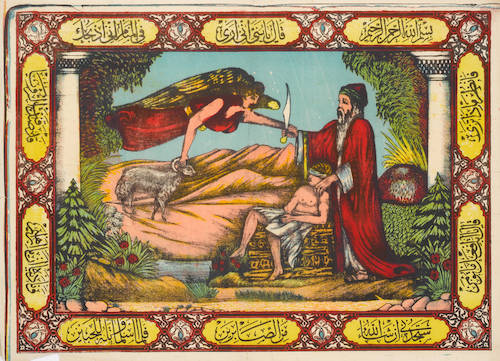
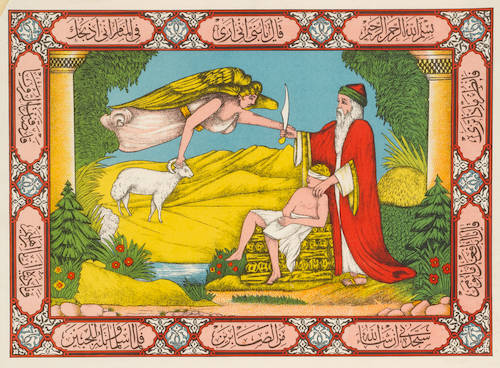
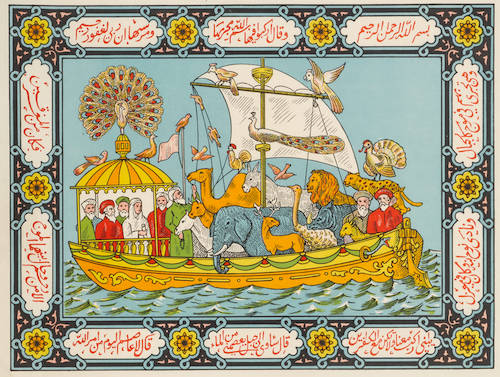
The set I looked at consists of ten chromolithographs that, according to the owner Ali Ahmed, were produced in Cairo in the 1920s. This coincides with the period during which according to one of the scholars who studied these prints, Peter Schienerl, this tradition of chromolithography took roots in Cairo. They illustrate Nuh/Noah’s Ark, Ibrahim/Abraham about to sacrifice his son Ishmael/Isaac, the court of King Solomon, al-Buraq, the Imam Ali ibn Talib accompanied by his sons Hassan and Husayn, and Khaled bin al-Walid. The chromolithographs are of two different sizes, 416x567mm and 250x330mm. The set of larger prints includes Nuh/Noah’s Ark, Ibrahim/Abraham’s sacrifice, al-Buraq, Ali with his sons, and Khaled bin al-Walid. The smaller prints illustrate Nuh/Noah’s Ark (2x), Ibrahim/Abraham’s sacrifice and al-Buraq. The printer’s marks are only visible on some of the larger prints and, according to Bonham’s (yes, I need to get back to my Arabic lessons), they identify their producer as Matba’at al-funun al-Jamilah. This appears to be the company, Fine Art Printers, to which Schienerl refered to as the major producer of what religious chromolithographs in Cairo between the 1920s and the mid 1970s. The smaller prints lack printer’s marks. I am not sure whether they are of the same age as the larger prints. Schienerl suggested that the smaller prints represented another generation of religious chromolithographs that emerged in the 1970s. But, who am I to question the assessment of the owner.
Personally, I was particularly surprised by the quality of the larger prints. Unlike the prints I collected in Kano, they displayed a larger variety of colours and shading was executed more delicately. The smaller chromolithographs, however, were characterised by a reliance on block colours and hatching similar to the Nigerian prints. I think this is particularly apparent if one compares the larger sized chromolithograph depicting Abraham attempting to sacrifice Ishmael/Isaac with the smaller sized one in the set and the print I collected in Nigeria in 2008 (sorry, Bonham reserves the copyright for its images so I can’t juxtapose them here, instead pls. make use of the links).
Again, some of the chromolithographs in the set displayed a close resemblance to the respective motif in the set of prints I collected in Kano. These include the illustrations of Nuh/Noah’s Ark, Ali and his sons, al-Buraq and Abraham’s sacrifice of Ishmael/Isaac.
Interestingly enough, the larger of three prints in the set illustrating Nuh/Noah’s Ark presents the motif on a plane sheet of paper without any decorative borders but includes inscriptions including of the shahada on the ship’s pennant. In this it resembles an illustration of the same motif by Kriss & Kriss Heinrich and collected in Cairo in the 1950s as well as the print I collected in Kano in 2008. The two smaller sized chromolithographs are distinguished by a decorative border including (and here it comes again, I need to take Arabic lessons again) what I guess are the respective verses from the Qur’an. They also present a mirror version of the motif depicted in the larger print in the set. No other inscriptions have been incorporated into the image. In all but the absence of the inscription in the pennant, the Nigerian print appears to follow the larger of the three chromolithographs.
Another interesting aspect that was raised during the conversation with the prints’ current owner Ali Ahmed: He explained that this kind of images was more closely associated with Shi’ism rather than practices of Sunni Islam. Interestingly enough, Elisabeth Puin and Schienerl indeed argued that this tradition of religious imagery may be traced back to Iran. However, these images appear to have been produced and found audiences among Muslim populations in an area stretching from Morocco to the west to Syria in the east, from the costs of the Mediterranean to the north to the Sahel belt to the south. If I am not mistaken, the areas on the African continent are predominantly, if not exclusively, Sunni. So the appeal of these images cannot be limited to Shia Islam. Maybe, Khenchelaoui provided a clue here when he discussed similar chromolithographs within the context of pious practices associated with Sufi Islam in Algeria, in particular the reverence of the Sheikh Abd al-Qadir al-Jilani. Or, maybe, Ahmed’s assessment reflected contemporary interpretations of Islam’s teaching about the arts and the use of religious imagery that have changed since the period during which these chromolithographs were produced in Egypt. I don’t know (yet) but these certainly are interesting questions to explore. No?
All references here. (Oh, the ease of inserting just one link, I should have posted my bibliography on a separate but associated page much earlier!)
Chika Okeke convenes another virtual roundtable at the Nka blog.
Nka Roundtable III: “Contemporary African Art and the Museum”
Over the next several weeks curators and directors of major museums in the United States, Germany, Japan, South Africa and the UK will engage in spirited but substantial discussion on the relationship between contemporary African art and the museum. I expect excursions into the history of this relationship, its crucial moments, state of affairs, and challenges that remain. In the process, we shall debate issues of presenting this material in art and ethnology museums; the politics of acquisitions and display; museums and scholarship; and the place of contemporary African art–relative to the “traditional” and western contemporary. I suspect that there will be surprising turns in the course of our discussion, but I am certain that the deliberations of this diverse, unprecedented and distinguished panel of curators will surely be of immense value to students and scholars working or interested in this exciting, dynamic field. Please join us!
Convener: Chika Okeke-Agulu (Princeton University)
Participants: Marla Berns (Director, Fowler Museum of Cultural History, University of California, Los Angeles), Christa Clarke (Senior Curator, Newark Museum, Newark, NJ), Laurie Ann Farrell (Director of Exhibitions, Savannah College of Art & Design Gallery, Savannah, GA), Khwezi Gule (Chief Curator, Hector Pieterson Memorial, Johannesburg), Kinsey Katchka (independent scholar/curator), Yukiya Kawaguchi (Associate Professor/Curator, National Museum of Ethnology, Osaka), Clive Kellner (Curator-at-Large, The Gordon Schachat Collection, Johannesburg), Karen Milbourne (Curator, Smithsonian National Museum for African Art, Washington DC), Raison Naidoo (Director Arts Collections, Iziko: South African National Gallery, Cape Town), Enid Schildkrout (Chief Curator/Director of Exhibitions, Museum for African Art, New York) Chris Spring (Curator, British Museum, London), Ulf Vierke (Director, Iwalewa-Haus, University of Bayreuth, Bayreuth), Okwui Enwezor, Salah M. Hassan.
Surely, once again, worth following closely … Find it here.